How to Write to a File Without Newline in Python?

Write to a File Without Newline in Python Problem with Newlines

I encountered a problem with writing a file without a newline while working on a project for my clients. The goal was to ensure that each entry was appended to the file without unnecessary newlines, which could disrupt data processing later on. In this tutorial, I will explain how to write to a file without … Read more >>

How to Check Array Equality in TypeScript?

Check Array Equality in TypeScript

As a developer, you might encounter scenarios where you need to verify the equality of arrays, such as comparing user preferences, validating data integrity, or optimizing performance. In this tutorial, I will explain how to check if two arrays are equal using TypeScript. Understanding Array Equality in TypeScript First, Let me explain what we mean … Read more >>

How to Sort String Arrays in TypeScript

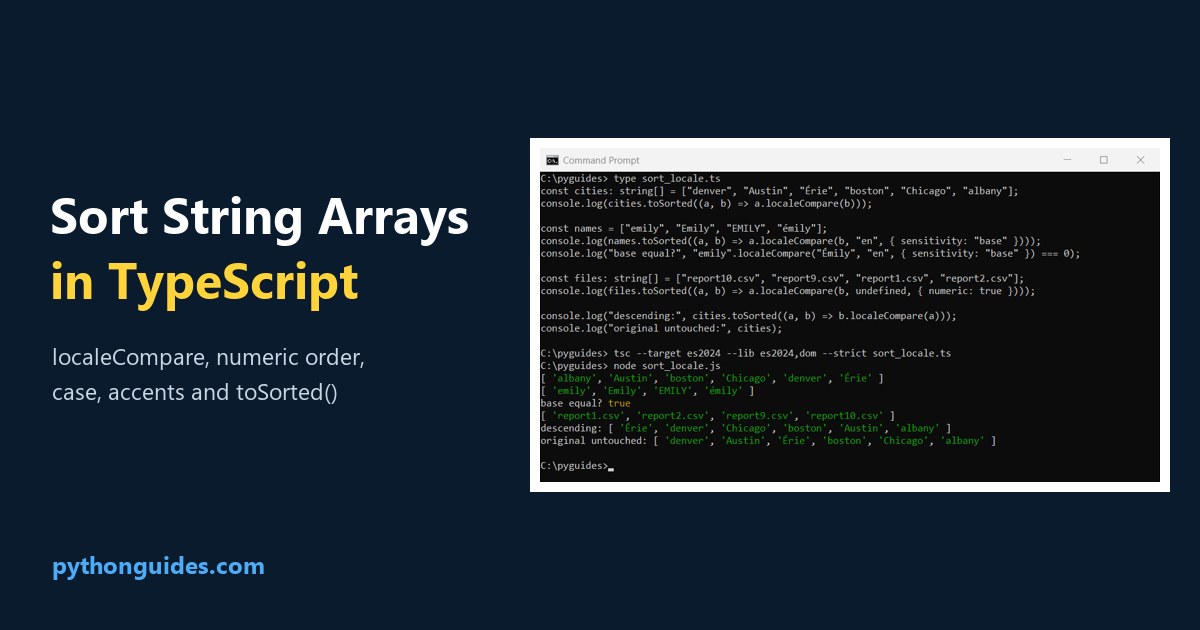
TypeScript sort string array: Command Prompt output of localeCompare with numeric and sensitivity options

To sort a string array in TypeScript, pass a compare function that uses localeCompare(): names.sort((a, b) => a.localeCompare(b)). A bare sort() compares UTF-16 code units, so capitals, accents and numbers inside strings land in surprising places: For this page the toolchain was TypeScript 7.0.2 under Node.js v22.22.2, with strict checks turned on, and the console … Read more >>

How to Convert TypeScript Enums to Arrays?

Convert TypeScript Enums to Arrays

In this tutorial, I will explain how to convert TypeScript enums to arrays with detailed examples. As a developer, I encountered a situation where I needed to dynamically generate a list of options for a dropdown menu in a TypeScript application. This required me to convert an enum to an array in the Typescript code. … Read more >>

How to Delete a File if it Exists in Python?

Delete a File if it Exists in Python

In this tutorial, I will explain how to delete a file if it exists in Python. As a Python developer working on a project for one of my clients, I came across a scenario where I needed to delete a file which is existing, this made me explore more about this topic. I will share … Read more >>

How to Create a File in Python if It Doesn’t Exist?

Create a File in Python if It Doesn't Exist

In this tutorial, I will explain how to create a file in Python if it doesn’t exist. As a developer working on various projects, I came across a scenario while working on files, where I needed to create a file in Python which do not exist, this made me explore more about creating files. Let … Read more >>

How to Write JSON Data to a File in Python

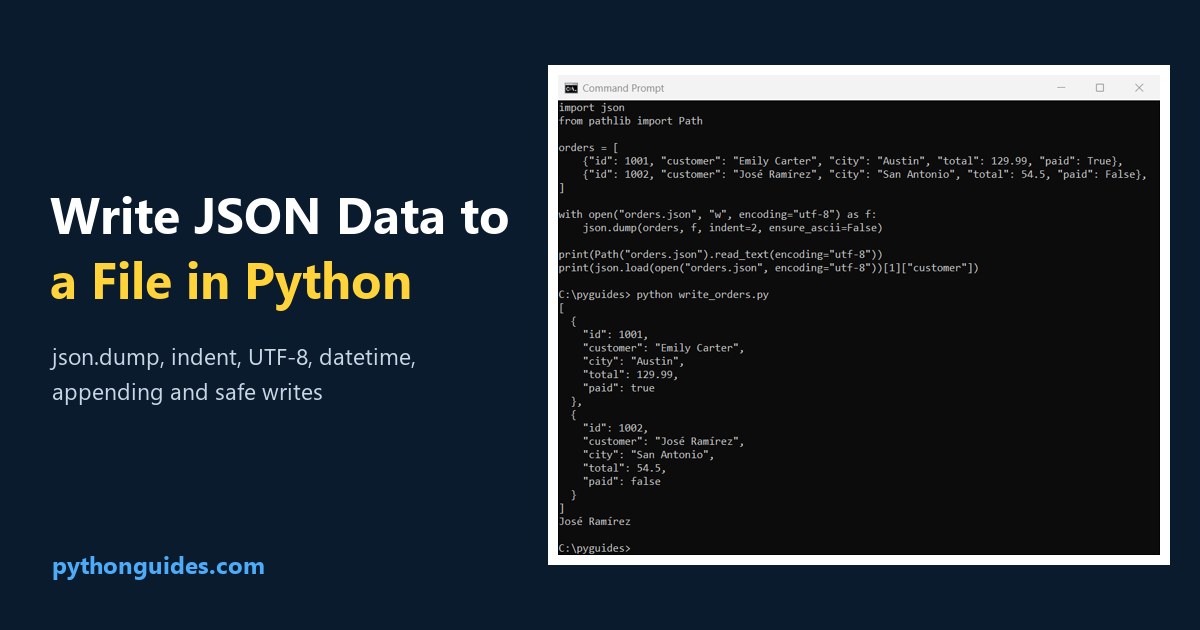
Python write JSON to file: Command Prompt output of json.dump writing an indented orders.json file

To write JSON data to a file in Python, open the file in write mode and call json.dump(data, f). Add indent=2 for readable output, and open the file with encoding=”utf-8″ so names with accents survive: These snippets ran on Python 3.12.5 in a Windows Command Prompt, where encoding mistakes show up fast. You’ll see json.dump … Read more >>

How to Close a File in Python?

Close a File in Python

In this tutorial, I will explain how to close a file in Python after opening it. Recently in a Python webinar on the topic of files, someone raised a question about closing a file. After discussion, we found several effective methods to achieve this task. I will explain those important methods with examples. Close a … Read more >>

How to Save Variables to a File in Python?

Save Variables to a File in Python

In the Python webinar, the topic of discussion was on how to save variables to a file in Python. After experimenting and researching various methods I found several ways to achieve this task. In this article, I will explain how to save variables to file in Python with accurate examples and screenshots of executed example … Read more >>

How to Read a Specific Line from a Text File in Python

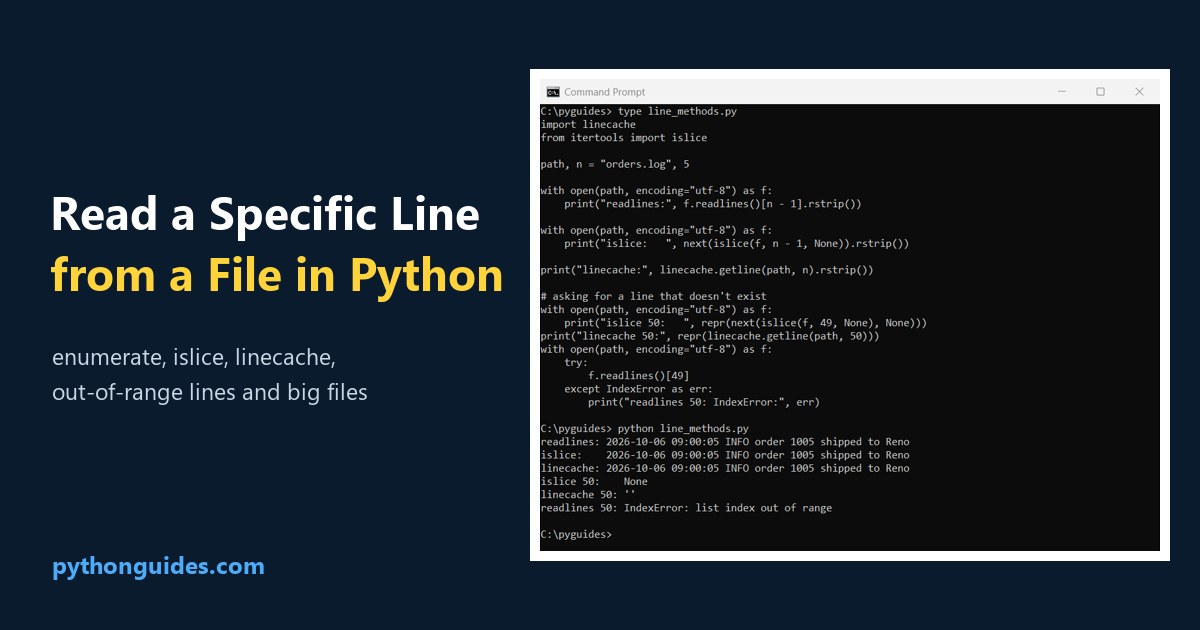
Python read specific line from file: Command Prompt output comparing readlines, islice and linecache

To read a specific line from a text file in Python, loop over the file with enumerate(f, start=1) and return the line when the counter matches. It streams the file, so size doesn’t matter. linecache.getline(path, n) is the one-call option: To check the behaviour of each method, including what happens past the end of the … Read more >>