Multiple Linear Regression in Python (scikit-learn and statsmodels)

Multiple linear regression in Python: actual vs predicted home prices scatter plot

Multiple linear regression in Python predicts one number from several inputs. With scikit-learn it takes three lines: pick your feature columns, call LinearRegression().fit(X, y), and read the coefficients: To make the results checkable, I simulated 400 home sales where I know the true effect of each feature, then fit models with Python 3.12.5, scikit-learn 1.9.1 … Read more >>

51 Scikit Learn Interview Questions And Answers

Scikit Learn Interview Questions And Answers

Getting a handle on Scikit-Learn is pretty much a must for anyone diving into machine learning or data science. This Python library packs a bunch of tools for data preprocessing, model training, and evaluation. If you can tackle interview questions about Scikit-Learn, you’ll show off both real-world skills and the kind of theory employers want … Read more >>

Scikit-Learn Confusion Matrix

confusion matrix sklearn

As a Python developer with over a decade of experience, I’ve seen firsthand how crucial evaluation metrics are when building machine learning models. One of the most fundamental tools to assess classification models is the confusion matrix. In this article, I’ll walk you through what a confusion matrix is, how to generate one using Scikit-Learn, … Read more >>

Non-Linear Models with Scikit-Learn

non linear regression python

As a Python developer with over a decade of experience, I’ve seen firsthand how crucial it is to handle complex, non-linear relationships in data. While linear models are easy and often a good starting point, real-world data, especially from diverse US markets like finance, healthcare, or marketing, rarely follows a simple straight line. That’s where … Read more >>

Scikit-Learn Gradient Descent

stochastic gradient descent sklearn

As a Python developer with over a decade of experience, I’ve seen firsthand how essential Gradient Descent is in machine learning. Whether you’re tweaking linear regression models or diving into neural networks, understanding Gradient Descent can dramatically improve your model’s performance. In this article, I’ll walk you through how to use Gradient Descent with Scikit-Learn, … Read more >>

Genetic Algorithms with Scikit-Learn in Python

sklearn genetic algorithm

I’ve been working with Python for over a decade, and throughout my journey, I’ve explored numerous optimization techniques. One approach that has fascinated me is the genetic algorithm, a powerful method inspired by natural selection. When combined with Scikit-Learn, it offers a unique way to optimize machine learning models beyond traditional methods. If you’re like … Read more >>

scikit-learn accuracy_score: Usage and When It Misleads

scikit-learn accuracy_score: the Command Prompt showing a model scoring 98 percent accuracy while catching none of the fraud cases

The accuracy_score in sklearn returns the fraction of predictions that match the truth. Here’s the import and the whole call: It takes the true labels first and the predictions second. Swapping them gives the same number, so the mistake hides, but every other metric in sklearn.metrics cares about the order. Everything here ran on scikit-learn … Read more >>

Scikit-learn Logistic Regression: Build a Churn Classifier in Python

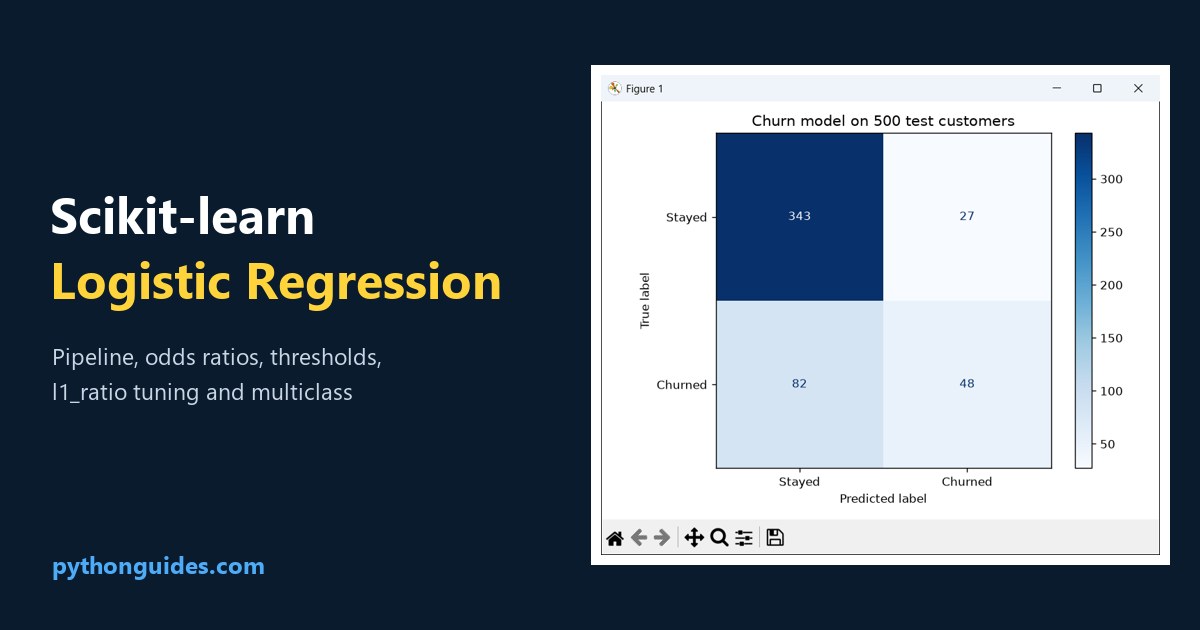
Scikit-learn logistic regression: confusion matrix plot of a churn model on 500 test customers

Summit Stream, a made-up video streaming service in Denver, wanted to know which subscribers are about to cancel. A scikit-learn logistic regression model answers that with a churn probability for each customer, using LogisticRegression inside a pipeline. In this tutorial, I’ll build that scikit-learn logistic regression churn model step by step, from a CSV of … Read more >>