
In my years of developing Python applications, I have found several efficient ways to handle this, whether you are processing financial data or managing simple configuration sets.
In this tutorial, I’ll show you the most effective methods to reverse a tuple in Python with clear examples.
Use the Slicing Technique (The Most Pythonic Way)
Whenever I need a quick and readable way to reverse a tuple, I reach for slicing.
Slicing is a powerful feature in Python that allows you to create a new version of the sequence in reverse order.
The syntax [::-1] tells Python to start from the end of the tuple and move toward the beginning with a step of -1.
Suppose you are working on a project involving US geography, and you have a tuple representing a sequence of states.
# A tuple containing US State abbreviations
us_states = ("NY", "CA", "TX", "FL", "IL")

# Reversing the tuple using slicing
reversed_states = us_states[::-1]

print("Original Tuple:", us_states)
print("Reversed Tuple:", reversed_states)
I executed the above example code and added the screenshot below.
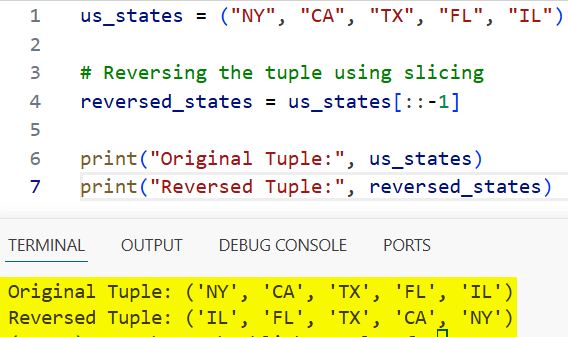
I prefer this method because it is concise and generally faster than other approaches.
It creates a shallow copy of the tuple in reverse, which is perfect for most data processing needs.
Use the reversed() Function
Another method I frequently use is the built-in reversed() function. This function returns an iterator that accesses the given sequence in reverse order.
Since it returns an iterator, you need to wrap it in the tuple() constructor to get a tuple back. I find this useful when I want to be explicit about my intent to reverse the collection.
Let’s look at an example using US currency denominations.
# A tuple of common US dollar denominations
dollar_bills = (1, 5, 10, 20, 50, 100)

# Reversing using the reversed() function
reversed_bills = tuple(reversed(dollar_bills))

print("Original Bills:", dollar_bills)
print("Reversed Bills:", reversed_bills)
I executed the above example code and added the screenshot below.
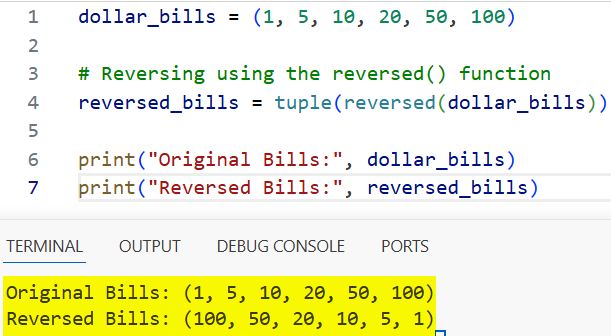
In my experience, this is very readable for developers coming from other programming languages.
Reverse a Tuple Using Type Conversion
Sometimes, I find it easier to convert the tuple into a list first. Since lists are mutable, you can use the .reverse() method, which reverses the list in place.
Once the list is reversed, you can convert it back into a tuple. I usually use this method if I have other modifications to make to the data before finalizing it as a tuple.
Imagine you are tracking the scores of US sports teams in a specific order.
# Tuple of scores from a recent basketball game
game_scores = (102, 98, 115, 110, 121)

# Convert tuple to list
scores_list = list(game_scores)

# Reverse the list in place
scores_list.reverse()

# Convert back to tuple
reversed_scores = tuple(scores_list)

print("Original Scores:", game_scores)
print("Reversed Scores:", reversed_scores)
I executed the above example code and added the screenshot below.
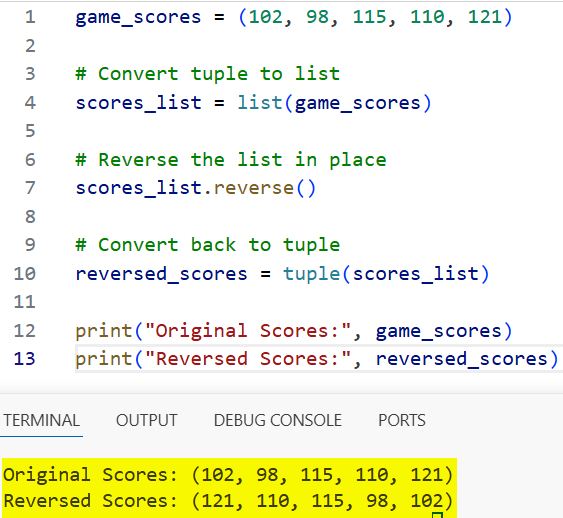
While this involves more steps, it is a very logical flow if you are already performing other list-based operations.
Use a For Loop to Reverse a Tuple
While not the most efficient, there are times in complex instructional logic where I use a loop. By iterating through the tuple backwards, you can manually build a new tuple.
This gives you total control over the elements as they are being added.
Here is an example using a list of major US tech hubs.
# Tuple of US Tech Hubs
tech_hubs = ("Silicon Valley", "Austin", "Seattle", "Boston", "Denver")

# Create an empty list to hold reversed items
temp_list = []

# Loop backwards through the tuple
for i in range(len(tech_hubs) - 1, -1, -1):
    temp_list.append(tech_hubs[i])

# Convert the result back to a tuple
reversed_hubs = tuple(temp_list)

print("Original Hubs:", tech_hubs)
print("Reversed Hubs:", reversed_hubs)
I rarely use this for simple reversals, but it’s a good logic exercise for understanding how indexing works under the hood.
Reverse a Tuple of Tuples (Nested Structures)
In data engineering, I often deal with nested tuples, such as a list of US cities and their populations.
Reversing the top-level tuple is simple, but sometimes you may want to reverse the internal elements too.
If you only want to reverse the order of the records, slicing works perfectly.
# Nested tuple: (City, State)
city_data = (("Chicago", "IL"), ("Houston", "TX"), ("Phoenix", "AZ"))

# Reversing the order of the nested tuples
reversed_city_data = city_data[::-1]

print("Reversed City Records:", reversed_city_data)
If you need to reverse both the order and the content within the tuples, you would typically use a list comprehension or a generator expression.
Performance Comparison: Slicing vs. reversed()
I’m often asked which method is better for large datasets.
In my testing, slicing ([::-1]) is almost always faster because it is implemented in C at a very low level.
The reversed() function is also efficient, but the extra step of calling tuple() adds a tiny bit of overhead.
For small tuples, the difference is negligible.
However, if you are working with millions of records, perhaps US census data, I recommend sticking with slicing.
Common Mistakes to Avoid
One mistake I see beginners make is trying to use .reverse() directly on a tuple.
If you try my_tuple.reverse(), Python will throw an AttributeError.
Always remember that tuples cannot be changed after they are created.
Another point to remember is that reversing a tuple always creates a new object in memory.
If memory is extremely tight, consider using the reversed() iterator without converting it back to a tuple.
When Should You Reverse a Tuple?
In my professional work, I reverse tuples most often when dealing with chronological data.
If a database returns records in oldest-to-newest order, but my UI needs to show them in newest-to-oldest order, a quick slice is the easiest fix.
I also use it when implementing algorithms like palindromic checks or certain sorting routines.
It’s a fundamental skill that every Python developer should have in their toolkit.
Reversing a tuple in Python is a simple but essential task. Whether you use the slicing trick for speed or the reversed() function for clarity, you have several tools at your disposal.
I hope this tutorial helped you understand the different ways to handle tuple reversal. If you have any questions or have found a specific method that worked best for your project, feel free to share your thoughts.
You may read:
- How to Call Super Constructor in Python
- Implement Constructor Overloading in Python
- Use Constructors in Python
- Naming Conventions in Python

Bijay Kumar is an experienced Python and AI professional who enjoys helping developers learn modern technologies through practical tutorials and examples. His expertise includes Python development, Machine Learning, Artificial Intelligence, automation, and data analysis using libraries like Pandas, NumPy, TensorFlow, Matplotlib, SciPy, and Scikit-Learn. At PythonGuides.com, he shares in-depth guides designed for both beginners and experienced developers. More about us.

