
When working with jQuery, one of the most common tasks developers face is navigating through DOM elements to find specific elements with particular classes. Finding the next element with a class is a fundamental skill that every jQuery developer should master.
This comprehensive tutorial will walk you through various methods and techniques to accomplish this task effectively.
jQuery Element Navigation
jQuery provides several powerful methods for traversing the DOM tree. The key to finding the next element with a class lies in understanding how these traversal methods work together. The primary methods we’ll focus on are .next(), .nextAll(), .find(), and .closest().
Method 1: Use .next() for Immediate Siblings
The simple approach is using the .next() method when you need to find the immediately following sibling element with a specific class.
Basic Syntax
$(selector).next('.class-name')Example: Find the Next Sibling with a Class
<div class="container">
    <div class="current-element">Current Element</div>
    <div class="target-class">Next Element</div>
    <div class="another-element">Another Element</div>
</div>
// Find the next element with class 'target-class'
var nextElement = $('.current-element').next('.target-class');
console.log(nextElement.text()); // Output: "Next Element"I executed the above example code and added the screenshot below.

The .next() method only looks at the immediately following sibling element. If that element doesn’t match your class selector, it returns an empty jQuery object.
Method 2: Use .nextAll() for Multiple Siblings
When the target element isn’t the immediate sibling, use .nextAll() to search through all following siblings.
Syntax and Usage
$(selector).nextAll('.class-name').first()Practical Example
<ul class="menu">
    <li class="menu-item active">Home</li>
    <li class="menu-item">About</li>
    <li class="menu-item">Services</li>
    <li class="menu-item highlight">Contact</li>
</ul>
// Find the next element with class 'highlight'
var highlightedItem = $('.active').nextAll('.highlight').first();
highlightedItem.css('background-color', 'yellow');I executed the above example code and added the screenshot below.

Method 3: Traverse Complex DOM Structures
In real-world scenarios, you often need to navigate more complex DOM structures. This is where combining .closest() and .find() becomes essential.
Working with Table Rows
<table>
    <tr>
        <td><button class="edit-btn">Edit</button></td>
        <td>John Doe</td>
    </tr>
    <tr>
        <td><span class="status">Active</span></td>
        <td>Status Row</td>
    </tr>
</table>
// Find the status element in the next table row
$('.edit-btn').closest('tr').next().find('.status');I executed the above example code and added the screenshot below.

This approach goes up to the parent <tr> element, finds the next row, then searches within it for the target class.
Method 4: Advanced Techniques with Filtering
Sometimes you need more sophisticated filtering to find exactly the element you want.
Using Custom Filters
// Find the next element with a specific class and attribute
var nextSpecialElement = $('.current').nextAll().filter('.special-class[data-active="true"]').first();
Combine Multiple Conditions
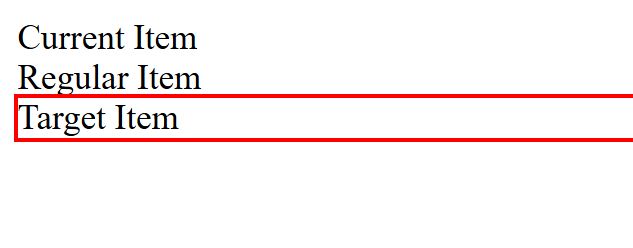
<div class="section">
    <div class="item current">Current Item</div>
    <div class="item">Regular Item</div>
    <div class="item premium active">Target Item</div>
</div>
// Find next element with both 'premium' and 'active' classes
var targetElement = $('.current').nextAll('.item.premium.active').first();I executed the above example code and added the screenshot below.
Practical Use Cases and Examples
Let me explain to you the practical use cases and examples of jQuery finding the next element with a class.
Example 1: Accordion Navigation
Toggles the following accordion section open/closed.
$('.accordion-header').click(function() {
    var content = $(this).nextAll('.accordion-content').first();
    content.slideToggle();
});
Example 2: Form Validation Messages
Shows or hides the next inline error message on blur.
$('.form-field').on('blur', function() {
    var errorMessage = $(this).nextAll('.error-message').first();
    if ($(this).val() === '') {
        errorMessage.show().text('This field is required');
    } else {
        errorMessage.hide();
    }
});
Example 3: Dynamic Content Loading
Appends a new item into the adjacent content container on click.
$('.load-more-btn').click(function() {
    var contentContainer = $(this).nextAll('.content-container').first();
    // Load and append new content
    contentContainer.append('<div class="new-content">Loaded content</div>');
});
Performance Considerations
When searching for elements, consider performance implications:
- Use specific selectors: Instead of .nextAll(‘.class’), use .nextAll(‘div.class’) if you know the element type
- Limit scope: Use .first() to stop searching after finding the first match
- Cache jQuery objects: Store frequently accessed elements in variables
// Good practice: cache the current element
var $current = $('.current-element');
var nextTarget = $current.nextAll('.target').first();
Common Issues and Solutions
Here are some common issues that may occur while finding the next element with a class and solutions to them.
Issue 1: Not Handling Empty Results
Forgetting to check if the target element actually exists before using it.
// Always check if elements exist
var nextElement = $('.current').nextAll('.target').first();
if (nextElement.length > 0) {
    nextElement.addClass('found');
}
Issue 2: Incorrect DOM Structure Assumptions
Assuming a fixed DOM structure instead of adapting to layout variations.
// Use more flexible approaches for varying structures
var nextElement = $('.current').parent().nextAll().find('.target').first();
Browser Compatibility and Best Practices
jQuery’s traversal methods work consistently across all modern browsers. However, always ensure you’re using a compatible version of jQuery for your target browsers.
Best Practices:
- Always check if elements exist before manipulating them
- Use method chaining efficiently
- Consider using more specific selectors for better performance
- Test your code with different structures of the DOM
Conclusion
Finding the next element with a class in jQuery involves understanding the relationship between elements in the DOM tree. Whether you’re using .next() for immediate siblings, .nextAll() for broader searches, or combining methods for complex structures, the key is choosing the right approach for your specific use case.
Master these techniques, and you’ll be able to navigate and manipulate DOM elements with confidence, creating more dynamic and interactive web applications. Remember to always consider performance and handle edge cases in your code for robust, production-ready solutions.
You may also like to read other articles on jQuery:
- JavaScript vs jQuery: Key Differences
- How to Fix “jQuery $ is not defined” Error
- How to Set Radio Button Checked in jQuery
- jQuery Get Selected Radio Button Value

Bijay Kumar is an experienced Python and AI professional who enjoys helping developers learn modern technologies through practical tutorials and examples. His expertise includes Python development, Machine Learning, Artificial Intelligence, automation, and data analysis using libraries like Pandas, NumPy, TensorFlow, Matplotlib, SciPy, and Scikit-Learn. At PythonGuides.com, he shares in-depth guides designed for both beginners and experienced developers. More about us.

