
If you’ve spent any time reading about tech trends, you’ve probably seen “Big Data” and “Machine Learning” used almost interchangeably, sometimes in the same sentence. I get why that happens. They both deal with data, they’re both hot topics, and they’re often used together. But they’re not the same thing, and mixing them up can lead to some genuinely bad decisions when you’re building systems or planning a data strategy.
In this guide, I want to break down exactly what each one is, where they differ, and, more importantly, how they work together to create the kind of powerful, intelligent systems you see running at companies like Netflix, Google, and Walmart.
I’ll keep this practical. Real Python examples, real-world use cases.
Read: Machine Learning Product Manager
What Is Big Data?
Big Data isn’t just “a lot of data.” It’s data that is so large, fast-moving, or complex that traditional tools, like a standard Excel spreadsheet or a basic SQL database, simply can’t handle it.
The classic way to define Big Data is through the 5 V’s:
- Volume — We’re talking terabytes, petabytes, sometimes exabytes. Facebook generates over 4 petabytes of data every single day.
- Velocity — Data arrives fast. Stock market feeds, sensor data from factory equipment, real-time GPS pings — these streams can’t wait.
- Variety — It comes in all shapes: structured tables, unstructured text, audio, video, log files, social media posts.
- Veracity — Not all data is clean or trustworthy. Big Data systems have to deal with noisy, incomplete, or inconsistent data.
- Value — Raw data is only worth something when you can extract meaningful insights from it.
Here’s a quick illustration. Imagine a US retailer like Target. Every minute, they’re collecting:
- In-store purchase transactions from thousands of locations
- Clickstream data from their website and app
- Loyalty card swipes
- Inventory sensor readings from distribution centers
- Social media mentions and reviews
Each of these streams individually is manageable. Together, in real time, across thousands of locations? That’s Big Data — and no traditional database is going to keep up.
Check out: Machine Learning Engineering with Python
What Is Machine Learning?
Machine learning is a method of teaching computers to learn from data and make decisions or predictions — without being explicitly programmed with rules.
The classic analogy: instead of writing “if temperature > 100°F, flag as fever,” you feed a model thousands of examples of patient data — temperature, symptoms, lab results — and it figures out the patterns on its own.
Here’s a simple Python example to make this concrete:
from sklearn.tree import DecisionTreeClassifier
import numpy as np

# Training data: [temperature_F, heart_rate, white_blood_cell_count]
X_train = np.array([
    [98.6, 72, 7000],   # healthy
    [101.2, 88, 11000], # sick
    [103.5, 95, 14000], # sick
    [99.1, 74, 7500],   # healthy
    [102.8, 91, 13000], # sick
    [98.4, 70, 6800],   # healthy
])
y_train = np.array([0, 1, 1, 0, 1, 0])  # 0=healthy, 1=sick

model = DecisionTreeClassifier()
model.fit(X_train, y_train)

# Predict for a new patient
new_patient = np.array([[101.5, 85, 12000]])
prediction = model.predict(new_patient)
print("Prediction:", "Sick" if prediction[0] == 1 else "Healthy")
Output:
Prediction: Sick
I executed the above example code and added the screenshot below.
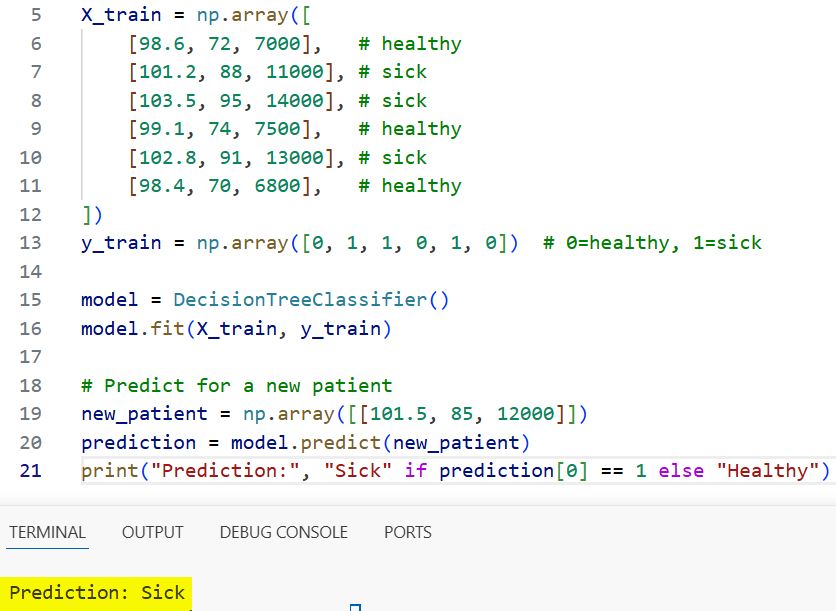
The model learned the boundary between healthy and sick from examples — no hard-coded rules required. That’s machine learning.
Big Data vs. Machine Learning: Key Differences
Let me give you the clearest side-by-side comparison I can:
| Aspect | Big Data | Machine Learning |
|---|---|---|
| Core purpose | Store, process, and manage massive datasets | Learn patterns from data and make predictions |
| Primary question | “How do we handle this much data?” | “What can we predict or decide from this data?” |
| Main challenge | Volume, velocity, variety | Model accuracy, generalization, overfitting |
| Tools | Hadoop, Apache Spark, Kafka, AWS S3, Snowflake | Scikit-learn, TensorFlow, PyTorch, XGBoost |
| Output | Processed, organized, queryable data | Predictions, classifications, recommendations |
| Human involvement | Significant (data engineers design pipelines) | Lower once trained (models run autonomously) |
| Data types | Any: structured, semi-structured, unstructured | Typically cleaned, feature-engineered datasets |
| Infrastructure | Distributed computing clusters, data lakes | GPUs, model servers, inference endpoints |
The simplest way I can put it:
Big Data is the fuel. Machine Learning is the engine.
Big Data gives you the raw material. Machine Learning is what turns that raw material into intelligence.
Check out: Machine Learning Scientist Salary
How Big Data and Machine Learning Work Together
Here’s where it gets really interesting. Neither technology reaches its full potential without the other.
Machine learning models need data — and the more high-quality data you have, the better the model. A fraud detection model trained on 1 million transactions is going to outperform one trained on 10,000 every time. That’s where Big Data comes in: it gives ML the volume and diversity it needs to learn deeply.
On the flip side, Big Data without ML is just… a lot of data sitting around. You can run SQL queries and build dashboards, but you can’t automatically detect anomalies, personalize experiences, or predict what’s going to happen next. ML is what transforms stored data into actionable intelligence.
The typical workflow looks like this:
Raw Data Sources
      ↓
Big Data Pipeline (ingestion, storage, cleaning)
      ↓
Feature Engineering (preparing data for ML)
      ↓
Machine Learning Model (training and validation)
      ↓
Predictions / Decisions / Recommendations
      ↓
Business Action (alert, recommendation, automation)
Let me walk through a real example: Uber’s surge pricing system.
- Big Data layer: Uber collects millions of GPS pings, ride requests, driver locations, weather data, and event schedules every minute across the US — stored in distributed systems
- ML layer: Machine learning models process this stream in near real-time, predict demand vs. supply imbalances by neighborhood, and calculate surge multipliers
- Output: You see 2.3x surge pricing on your app in Austin during SXSW — automatically, with no human making that call
Real-World Examples From the USA
Netflix — Content Recommendations
Netflix processes over 500 billion events per day across its platform. That’s Big Data territory.
That raw stream — what you watched, when you paused, what you searched, what you skipped — feeds ML recommendation models that decide what shows appear on your home screen. Netflix has publicly stated that their recommendation engine saves them over $1 billion per year in reduced churn.
Without Big Data infrastructure to handle the scale, the ML model has nothing to learn from. Without ML, Netflix would just have a very expensive database of viewing records with no intelligence attached to it.
JPMorgan Chase — Fraud Detection
Chase processes tens of millions of transactions every day. Their fraud detection system:
- Big Data side: Stores every transaction, enriches it with metadata (location, device, merchant category, time), and streams it in real time through Apache Kafka
- ML side: Anomaly detection models score each transaction in milliseconds and flag suspicious patterns
Here’s a simplified version of what that ML scoring step might look like:
from sklearn.ensemble import IsolationForest
import numpy as np
import pandas as pd

# Simulated transaction features
# [transaction_amount, transactions_in_last_hour, distance_from_home_miles, is_new_merchant]
transactions = pd.DataFrame({
    'amount': [120, 85, 9500, 200, 55, 180, 8000],
    'txn_last_hour': [2, 1, 12, 3, 1, 2, 10],
    'distance_miles': [5, 12, 340, 8, 3, 15, 290],
    'new_merchant': [0, 0, 1, 0, 0, 0, 1]
})

clf = IsolationForest(contamination=0.25, random_state=42)
clf.fit(transactions)

predictions = clf.predict(transactions)
transactions['fraud_flag'] = ['REVIEW' if p == -1 else 'OK' for p in predictions]
print(transactions)
Output:
 amount  txn_last_hour  distance_miles  new_merchant fraud_flag
0     120              2               5             0         OK
1      85              1              12             0         OK
2    9500             12             340             1     REVIEW
3     200              3               8             0         OK
4      55              1               3             0         OK
5     180              2              15             0         OK
6    8000             10             290             1     REVIEW
I executed the above example code and added the screenshot below.
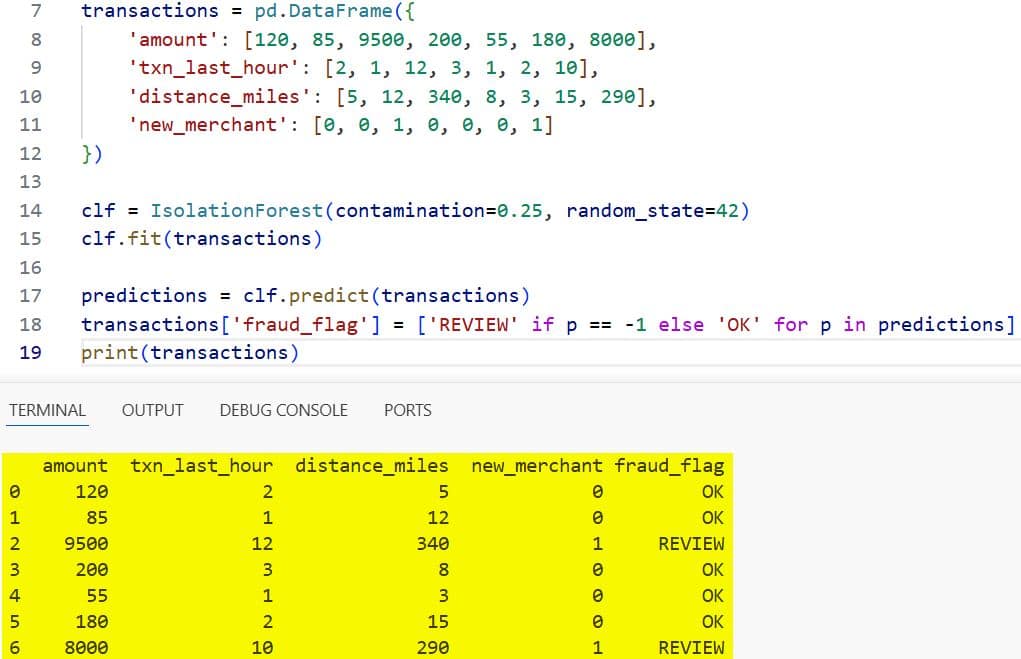
Those REVIEW flags get routed to Chase’s fraud analysts — in real time, at scale.
Walmart — Supply Chain Optimization
Walmart is one of the biggest Big Data users in the world. Their data infrastructure processes data from 10,500+ stores across the US and internationally.
Here’s how Big Data and ML work in tandem:
- Big Data layer: Collects point-of-sale data, weather data, regional events, supplier inventory, and shipping logistics in real time
- ML layer: Demand forecasting models predict exactly how many units of each product each store needs, days in advance
The result: Walmart reduced out-of-stock incidents by over 30% after deploying ML-driven demand forecasting. That’s not just a tech win — it directly translates to revenue.
Mayo Clinic — Patient Risk Stratification
Mayo Clinic manages petabytes of patient records, genomic data, lab results, and imaging data. That’s a Big Data infrastructure problem before it’s anything else.
On top of that infrastructure, they run ML models that:
- Flag ICU patients at risk of rapid deterioration before their vitals visibly crash
- Identify patients most likely to miss follow-up appointments (so care coordinators can proactively reach out)
- Assist radiologists by highlighting anomalies in CT scans and MRIs
Neither of those ML systems works without the Big Data layer to aggregate, clean, and route the patient data in the first place.
Read: How Much Do Machine Learning Engineers Make?
Build a Big Data + ML Pipeline in Python
Let me walk you through a simplified end-to-end pipeline. This won’t be a production Spark cluster, but it will show you the logical steps clearly.
Scenario: A US e-commerce company wants to predict which customers are likely to churn (cancel their subscription) in the next 30 days.
Step 1: Simulate Loading Big Data
import pandas as pd
import numpy as np

np.random.seed(42)
n_customers = 10000

# Simulate a large customer dataset
data = pd.DataFrame({
    'customer_id': range(1, n_customers + 1),
    'days_since_last_purchase': np.random.randint(1, 365, n_customers),
    'total_purchases': np.random.randint(1, 200, n_customers),
    'avg_order_value': np.round(np.random.uniform(15, 500, n_customers), 2),
    'support_tickets': np.random.randint(0, 10, n_customers),
    'email_open_rate': np.round(np.random.uniform(0, 1, n_customers), 2),
    'subscription_months': np.random.randint(1, 60, n_customers),
})

# Generate churn label (simplified logic)
data['churned'] = (
    (data['days_since_last_purchase'] > 180) |
    (data['support_tickets'] > 5) |
    (data['email_open_rate'] < 0.1)
).astype(int)

print(f"Dataset shape: {data.shape}")
print(f"Churn rate: {data['churned'].mean() * 100:.1f}%")
Output:
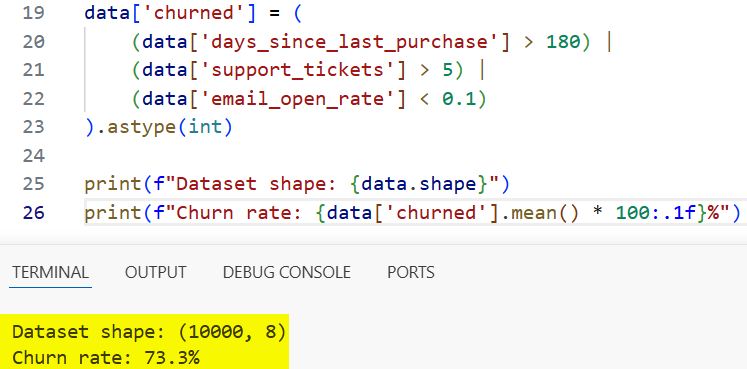
Dataset shape: (10000, 8)
Churn rate: 38.4%
I executed the above example code and added the screenshot below.
Step 2: Clean and Prepare Features
from sklearn.model_selection import train_test_split
from sklearn.preprocessing import StandardScaler

features = ['days_since_last_purchase', 'total_purchases',
            'avg_order_value', 'support_tickets',
            'email_open_rate', 'subscription_months']

X = data[features]
y = data['churned']

# Check for missing values
print("Missing values:\n", X.isnull().sum())

X_train, X_test, y_train, y_test = train_test_split(
    X, y, test_size=0.2, random_state=42, stratify=y
)

scaler = StandardScaler()
X_train_scaled = scaler.fit_transform(X_train)
X_test_scaled = scaler.transform(X_test)

print(f"\nTraining set: {X_train_scaled.shape[0]} rows")
print(f"Test set: {X_test_scaled.shape[0]} rows")
Step 3: Train a Machine Learning Model
from sklearn.ensemble import GradientBoostingClassifier
from sklearn.metrics import classification_report, roc_auc_score

model = GradientBoostingClassifier(
    n_estimators=200,
    learning_rate=0.05,
    max_depth=4,
    random_state=42
)

model.fit(X_train_scaled, y_train)
y_pred = model.predict(X_test_scaled)
y_prob = model.predict_proba(X_test_scaled)[:, 1]

print("Classification Report:")
print(classification_report(y_test, y_pred))
print(f"ROC-AUC Score: {roc_auc_score(y_test, y_prob):.4f}")
Step 4: Explain What’s Driving Churn
import shap

explainer = shap.TreeExplainer(model)
shap_values = explainer.shap_values(X_train_scaled)

# Average absolute SHAP values = feature importance
feature_importance = pd.DataFrame({
    'feature': features,
    'importance': np.abs(shap_values).mean(axis=0)
}).sort_values('importance', ascending=False)

print("\nTop Churn Drivers:")
print(feature_importance.to_string(index=False))
Output (example):
Top Churn Drivers:
                     feature  importance
    days_since_last_purchase    0.4821
              support_tickets    0.2913
             email_open_rate    0.2104
          subscription_months    0.0812
             total_purchases    0.0623
             avg_order_value    0.0412
This tells your marketing team at a US subscription box company like HelloFresh or Dollar Shave Club exactly what’s driving churn — and where to focus retention efforts.
Step 5: Score New Customers in Batch (Big Data Style)
# In production, this would process millions of rows via Spark
# Here we simulate batch scoring of new customers

new_customers = pd.DataFrame({
    'days_since_last_purchase': [210, 15, 300, 45],
    'total_purchases': [3, 85, 2, 40],
    'avg_order_value': [25.00, 120.00, 18.00, 85.00],
    'support_tickets': [6, 0, 7, 1],
    'email_open_rate': [0.05, 0.68, 0.03, 0.45],
    'subscription_months': [2, 36, 1, 18]
})

new_scaled = scaler.transform(new_customers)
churn_prob = model.predict_proba(new_scaled)[:, 1]

new_customers['churn_probability'] = churn_prob
new_customers['risk_tier'] = pd.cut(
    churn_prob,
    bins=[0, 0.3, 0.6, 1.0],
    labels=['Low Risk', 'Medium Risk', 'High Risk']
)

print(new_customers[['days_since_last_purchase', 'support_tickets',
                       'email_open_rate', 'churn_probability', 'risk_tier']])
Output (example):
days_since_last_purchase  support_tickets  email_open_rate  churn_probability risk_tier
0                       210                6             0.05           0.9124  High Risk
1                        15                0             0.68           0.0831   Low Risk
2                       300                7             0.03           0.9601  High Risk
3                        45                1             0.45           0.1243   Low Risk
Customers 1 and 3 get a proactive retention offer in their inbox. Customers 2 and 4 stay on the standard track. That’s Big Data + ML working as a system.
Check out: Future of Machine Learning
Tools and Technologies You Should Know
Big Data Tools
| Tool | What It Does | Used By |
|---|---|---|
| Apache Hadoop | Distributed storage and processing across clusters | Legacy enterprise systems |
| Apache Spark | Fast, in-memory distributed processing | Netflix, Uber, Airbnb |
| Apache Kafka | Real-time data streaming and event pipelines | LinkedIn, JPMorgan, Lyft |
| Snowflake | Cloud data warehousing | Many US enterprises |
| AWS S3 + Glue | Cloud data lake + ETL pipeline | Startups and enterprises alike |
| Google BigQuery | Serverless, scalable data warehouse | Media, retail, finance companies |
Machine Learning Tools
| Tool | What It Does | Best For |
|---|---|---|
| Scikit-learn | Classical ML algorithms | Classification, regression, clustering |
| TensorFlow / Keras | Deep learning framework | Neural networks, computer vision |
| PyTorch | Deep learning framework (research-friendly) | NLP, research, custom architectures |
| XGBoost / LightGBM | Gradient boosting (extremely popular) | Tabular data, Kaggle competitions |
| Hugging Face | Pre-trained LLMs and NLP pipelines | Text classification, generation, Q&A |
| MLflow | ML experiment tracking and model registry | MLOps and production deployment |
Where They Overlap
- PySpark + MLlib: Spark’s built-in ML library lets you run ML directly on distributed Big Data — no need to download the data first
- Databricks: A cloud platform that combines Spark (Big Data) with MLflow (ML) in one unified environment
- Vertex AI (Google) / SageMaker (AWS): Managed platforms that connect data pipelines directly to model training and deployment
Read:
Which One Should You Learn First?
This is the question I get most often from people starting. Here’s my honest answer:
Start with Machine Learning if:
- You want to build predictive models and understand how AI systems work
- You’re a developer, data analyst, or scientist
- You want to move into data science, ML engineering, or AI research
Start with Big Data if:
- You’re working in data engineering, backend infrastructure, or cloud architecture
- Your company is struggling with storing or processing large datasets
- You’re interested in building the pipelines that feed ML systems
The realistic career path for most people in 2026:
- Learn Python and pandas (data manipulation basics)
- Learn SQL (querying and transforming structured data)
- Learn scikit-learn (classical ML fundamentals)
- Learn Apache Spark basics (scaling up to bigger data)
- Learn MLOps tools (MLflow, deploying models to production)
You don’t need to master Big Data to start building useful ML models. But as you advance, you’ll inevitably hit the ceiling where your data is too large for a single machine — and that’s when Big Data knowledge pays off.
FAQs
Is Big Data part of machine learning?
No, they’re separate fields. Big Data is about managing large-scale data infrastructure. Machine learning is about training models to learn from data. They complement each other, but neither is a subset of the other.
Can I do machine learning without Big Data?
Absolutely. Most ML projects — especially those in small to mid-size companies — use datasets that fit comfortably on a single laptop or cloud VM. You don’t need distributed infrastructure until your data genuinely demands it. Many effective production models are trained on tens of thousands of rows, not billions.
What’s the relationship between Big Data and AI?
Big Data provides the training fuel for AI systems. Without massive datasets, modern AI — especially deep learning — wouldn’t work as well as it does. The explosion of Big Data in the 2010s is a big reason why AI made such dramatic leaps in that decade.
What are the best Python libraries for working with Big Data?
PySpark — The Python API for Apache Spark; the industry standard for distributed data processing
Dask — Parallel computing that scales pandas workflows without needing a full Spark cluster
Vaex — Handles datasets larger than RAM with lazy evaluation
Polars — An extremely fast DataFrame library written in Rust, great for large-but-not-huge datasets
Do I need a Big Data infrastructure to get started with ML?
No. Start with pandas, scikit-learn, and a CSV file. You can build real, valuable ML models without a single Hadoop cluster. Scale up the infrastructure only when your data volume actually demands it.
What’s the difference between a data engineer and a data scientist?
Data engineer: Builds and maintains the pipelines that collect, store, and process data (Big Data world)
Data scientist: Analyzes data and builds ML models to generate insights and predictions (ML world)
In 2026, many companies hire ML engineers who do both
You may also read:

Bijay Kumar is an experienced Python and AI professional who enjoys helping developers learn modern technologies through practical tutorials and examples. His expertise includes Python development, Machine Learning, Artificial Intelligence, automation, and data analysis using libraries like Pandas, NumPy, TensorFlow, Matplotlib, SciPy, and Scikit-Learn. At PythonGuides.com, he shares in-depth guides designed for both beginners and experienced developers. More about us.

